「Matrix Audio」 N Series Desktop Separates System Reviewed by Renowned Hi-Fi Blogger Jiu Duan
·Review Basic Information

·Author: Jiu Duan
As one of the editors of The Headphone Guidebook, a senior contributing writer for publications like HIGH FIDELITY, a veteran moderator on audiophile forums such as headphoneclub.com, Erji.net, and Loxpo.com, and a co-host of the podcast "Jiu Duan Qi Tan", the author known as "Jiu Duan" is a renowned reviewer in the Hi-Fi field. He excels at grounding his evaluations in real-world usage scenarios and pain points. With profound professional knowledge as his foundation, he employs vivid, confident, and infectious language to clearly convey complex technologies, listening impressions, and purchasing logic to his readers.
Original URL: https://mp.weixin.qq.com/s/Qko6b8QkdkYCxKT0YxuZxw
Review Product: 「Matrix Audio」N Series Desktop Separates System
The text is as follows:
Thoughts from an in-depth experience with the 「Matrix Audio」 N Series Desktop Separates System.
Last year, a friend asked me how to set up a desktop headphone / active speaker system with a budget of less than 50,000 RMB. I stared at my phone for five minutes, unable to give a straightforward answer. It wasn’t because I lack experience with audio gears, but because the matter itself is genuinely challenging.
With 50,000 RMB, the budget is neither too high nor too low. If an audiophile were to spend it on a single component, the choice would be relatively simple. But when the goal is to build a complete desktop system — covering everything from the audio source to the DAC and the amplifier — the difficulty immediately multiplies. It’s not just a question of whether the budget is sufficient; it’s that every step involves potential pitfalls, each interconnected, where one wrong move and the whole setup falls apart.

What should you choose as the audio source? Network streamer, digital audio player, or simply using a computer as the source? Each of these three paths comes with its own set of headaches. For music streamers, the biggest issue is not knowing whether the sound quality is legit. There are plenty of brands making streamers, but many products boast impressive hardware specs only to fall apart at the software level. Apps lag, user interfaces are clunky, and the overall user experience is a mess. And that’s not even mentioning the headache many people feel at the thought of setting up networks, mounting NAS drives, or configuring UPnP. Is this about enjoying music or studying for a network engineer certification?
Then, using a computer should be simpler, right? Well, not exactly. Setting aside the fact that access to lossless audio files is becoming increasingly limited, just the issue of SRC is enough to cause headaches. The default SRC mechanism in the Windows system is nothing short of a nightmare for audiophiles chasing the ultimate sound quality. While macOS allows automatic adjustments through software, the underlying audio architecture of the system still imposes limitations, preventing it from achieving the same level of purity as dedicated streamers. On top of that, problems like ground loop noise and jitter that can be introduced during USB transmission may defeat the purpose of using even the finest DAC.
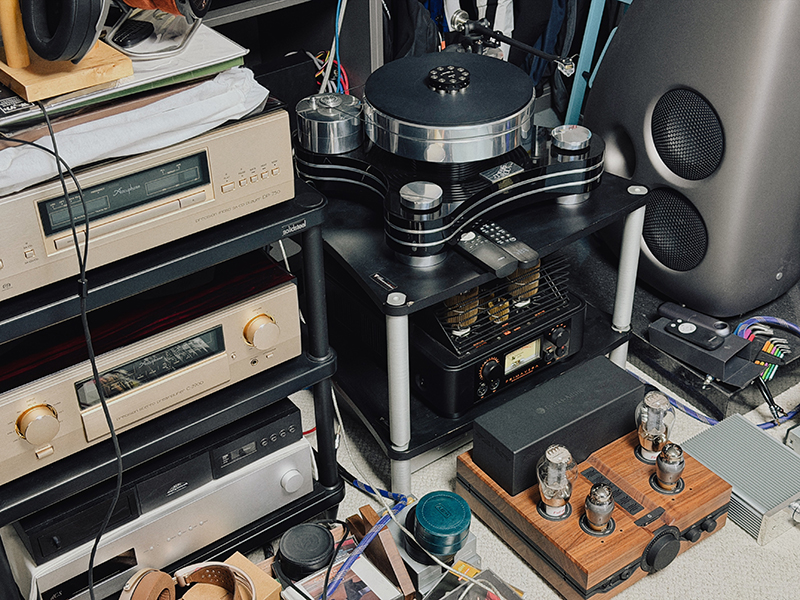
Once you finally settle on an audio source, the DAC becomes another battlefield. There’s no shortage of DACs on the market with impressive specs, but the headache is figuring out how to make its sound characteristics match your source device. Some DACs have good measurements, but as soon as you connect them to a particular audio transport, the sound can instantly become harsh and bright, or conversely, too soft and weak. This is all down to issues like input & output matching and clock synchronization — how would be ordinary audiophiles supposed to understand all these?
Amplifiers and preamps are actually the most troublesome part. You have to consider the hardware design, ensure they match the musical style of the streamer and DAC, and most critically, address the driving capability and compatibility with different headphones or speakers. An amp that drives the HD800S well might not handle Susvara properly, and one that pairs perfectly with the Utopia may sound completely off with the Meze Elite. This kind of synergy logic is something you simply can’t grasp without years of listening experience. This is what I consider the biggest pain point in building a headphone / speaker system. Each component on its own might be excellent, but when put together, they just don’t harmonize.

Matching a "multi-box-stack" is far more important than you might think.
This is precisely why the value of a set of "multi-box-stack" from the same brand becomes apparent.
Many people think that buying a full set of products from the same brand is just for convenience — a "lazy choice." In my view, this understanding is somewhat superficial. The real advantage of a multi-box-stack lies in the fact that engineers have already taken into account the parameter alignment, clock synchronization, signal transmission, and even tonal tuning of the entire system during the design phase. You don’t have to guess whether a particular DAC will be compatible with a certain transport, nor worry about whether the amplifier’s input sensitivity matches the DAC’s output level. It also reduces the number of uncertain variables in the signal path. All these "dirty and tedious tasks" have already been handled for you by the manufacturer’s R&D team.
Now, looking at the current market, 「Matrix Audio」 stands out as one of the brands that has taken the concept of a multi-box-stack to a relatively refined level — especially with their newly launched N Series Desktop Separates System: the NT-1 Digital Audio Transport, the ND-1 Audio DAC, and the NA-1 Headphone Amplifier. Having thoroughly tested this as my main setup recently, I believe that in the 50,000 RMB price range, it represents a multi-box-stack for headphone or speaker system that effectively addresses most of the pain points typical for this budget.
*The following text is presented for your convenience:
N Series Desktop Separates System, abbreviated as N Series
NT-1 Digital Audio Transport, abbreviated as NT-1
ND-1 Audio DAC, abbreviated as ND-1
NA-1 Headphone Amplifier, abbreviated as NA-1

Everything starts with appearance.
Inheriting the design language of the flagship MS-1, the contrasting color scheme exudes sophistication without being overly flashy.
The design language of the three units—NT-1, ND-1, and NA-1—is perfectly unified. The front panels of NT-1 and ND-1 feature large touchscreens, while all three are produced by CNC aluminum. The heat dissipation vents are styled into tastefully designed geometric patterns, and the overall lines of the units are clean and sharp. When placed side by side on a desk, paired with the TEMPO DX RACK+ and MA-DAMPER PRO co-branded by 「Matrix Audio」 and 「Audio Bastion」, the sense of ritual brought by this industrial aesthetic far surpasses that of individual components placed on an ordinary rack or desktop. The visual harmony of the entire system is exceptionally cohesive.

NT-1: The Ideal Digital Player in the Minds of Most People
Let’s start with the NT-1. The hardware architecture of NT-1 is directly inherited from 「Matrix Audio」’s flagship M Series, paired with the MA Player Hi-Fi Streamer OS which is a self-developed high-resolution audio playback system. In terms of power supply, the NT-1 is equipped with a large 60 Watts toroidal transformer, supported by multiple LDOs power supply circuits. The power for the digital core and other sections comes from independent windings, each processed through precise low-noise voltage regulation circuits. What’s the benefit of this? Purity. When NT-1 is connected to a DAC, the first impression for most users will likely be the exceptionally clean background, as the noise floor of this transport is impressively low.
The clock system is another standout feature of NT-1. Using a dual-mode femtosecond clock, NT-1 offers extremely high stability and remarkably low phase noise. This clock system is also inherited from the flagship M Series. In the internal clock mode, the decay details of instrumental reverberations are exceptionally rich. And if that’s not enough for you, there’s also a 10MHz external clock input on the back. Connecting it to 「Matrix Audio」 SC-1 Audio Grade Reference Clock will elevate the solidity and precision of the sound imaging to an even higher level.
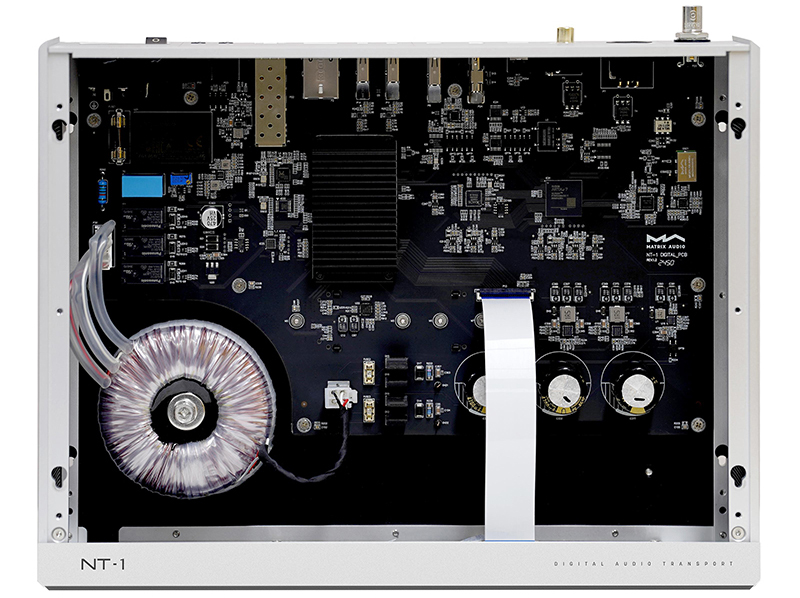
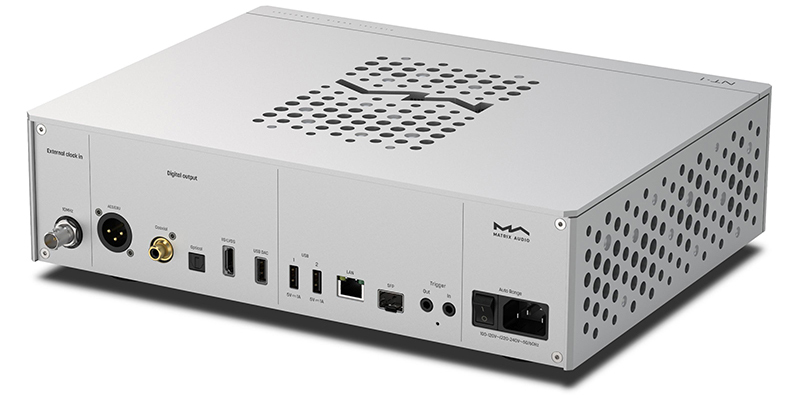
For interface, the NT-1 offers a complete set of digital outputs including USB, Optical, Coaxial, AES/EBU, and HDMI I²S, supporting up to 768kHz PCM and DSD512. For networking, besides the standard RJ45 Gigabit Ethernet port, it is equipped with an SFP port, allowing flexible use of optical or copper network modules. This is a very considerate design for advanced audiophiles with pre-installed fiber optic home networks.
Storage expansion is also generous. The bottom features an NVMe M.2 SSD slot supporting specifications of 2280/2260/2242. Moreover, this SSD slot has an independent ultra-low noise power supply design, resulting in a cleaner signal than ordinary NAS sources. The rear panel also houses two USB 3.0 ports for external hard drives, USB drives, or even CD drives. The NT-1 supports automatic CD ripping and storage to the local SSD, allowing veteran audiophiles to digitize their CD collections effortlessly.
However, none of these hardware specifications are as comforting as its operational experience. Audiophiles who have used various streamers know that the software of many can be a nightmare. Confusing menu logic, app crashes, and unstable network connections are issues that can ruin all goodwill towards any audio gears. The NT-1, however, is nearly flawless in this regard. The MA Remote App runs smoothly on both iOS and Android, supporting almost all mainstream streaming protocols and platforms like DLNA, UPnP, AirPlay 2, Roon Ready, TIDAL Connect, Spotify Connect, and Qobuz Connect. It can even play Apple Music natively. Power on/off, network connectivity, and interface response are exceptionally smooth, truly achieving a "pick up and use" experience for everyone.
ND-1: No Ethernet Port, But It Has Everything Else You Want
Next, let's talk about the ND-1. First, it must be said that this DAC indeed lacks an ethernet port. Some online comments call this a shortcoming, limiting its flexibility as a standalone DAC. This point isn't wrong in itself, but my view is that the ND-1 was never designed from the start to be used alone. It is the perfect partner for the NT-1, an indispensable part of this multi-box-stack. Connect it after the NT-1 via USB, AES, or Coaxial, and the sonic performance it delivers is something other DACs in the same price range simply can't match.
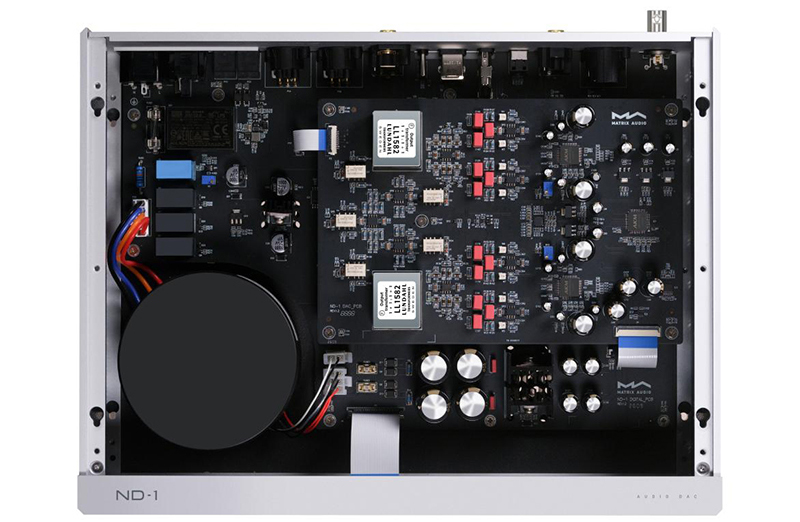
In its core DAC architecture, the ND-1 features AKM's flagship "1+2" discrete solution: one premium delta-sigma modulator AK4191EQ handles high-precision digital processing and reclocking while two AK4499EX chips adopt an independent channel architecture, dedicated to the digital-to-analog conversion of the left and right channels. This discrete architecture significantly suppresses jitter, optimizes channel separation and phase consistency, resulting in higher SNR and dynamic range.
For the clock section, the ND-1 features a 「Matrix Audio」 custom-designed ultra-low phase noise femtosecond clock and incorporates a DPLL clock synthesis circuit derived from the flagship MS-1, supporting external 10MHz clock input. This means you can not only feed high-quality digital signals via the NT-1 but also further enhance the system's clock precision. This multi-box-stack maintains a consistent pursuit of timing accuracy from source to end.

The most stunning design feature of ND-1, to me, is its dual-timbre output. The output stage is equipped with two separate circuits: one uses LUNDAHL precision transformers from Sweden for signal coupling, delivering a warm, mellow, and analog-rich sound; the other uses Op-Amp output, offering clear lines, sharp transients, and precise detail retrieval. You can freely switch between the two modes in the menu, essentially giving you two distinctly different listening styles with one DAC, adaptable to different headphones, music genres, or even moods. This design is rare among DACs in its price range.
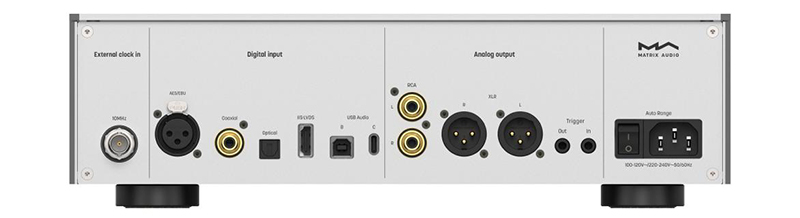
For digital input interfaces, ND-1 is equipped with a full matrix of inputs: Optical, Coaxial, AES/EBU, IIS-LVDS, USB Type B, and Type C. Each input is electrically isolated, effectively blocking common-mode interference and ground loop noise. Analog outputs provide both RCA and XLR, supporting output level adjustments of RCA 2 Vrms / XLR 4 Vrms and RCA 2.25 Vrms / XLR 4.5 Vrms. It also features 100-step high-precision digital volume attenuation, making it capable of driving a power amplifier or active speakers directly.
NA-1: Pure Class A, Fully Balanced, an All-Rounder Under 20,000 RMB
Finally, let's talk about NA-1. This is my favorite part of the entire multi-box-stack.
The NA-1 employs a pure Class A amplification circuit built with fully discrete components in a fully balanced architecture. It features four independent amplification modules, with no integrated op-amps used in the signal path — only carefully selected discrete transistors and resistors. The cost of this design is high expense, high power consumption, and significant heat generation, but the benefit is that sonic transparency and dynamic range can reach a very high level. NA-1's headphone output THD+N is below 0.0007%, and its preamp output is below 0.0003% — figures that are absolutely first-class even within the 20,000 RMB price bracket for headphone amplifiers.

In terms of power, the balanced output delivers 18W per channel at 33Ω, 4.5W at 300Ω, and 2.3W at 600Ω. The single-ended output provides 7W at 33Ω, 1.1W at 300Ω, and 580mW at 600Ω. This power reserve is sufficient to drive almost all common flagship headphones on the market. Whether it's high-impedance models like the HD800S or T1, or low-sensitivity planar magnetics like the Susvara or GL3000, the NA-1 handles them with ease. With an output impedance below 1Ω, it offers excellent control over headphones without altering their native frequency response due to impedance mismatch.
Power supply design is also a highlight of NA-1. An 80W potted toroidal transformer, with metal magnetic shielding enclosure, paired with a large capacitor array totaling 39,000µF, provides extremely ample current reserves. The preamp and power amp circuits are laid out on separate upper and lower PCBs, physically isolating the voltage amplification stage from the current amplification stage to effectively reduce interference and optimize heat dissipation.

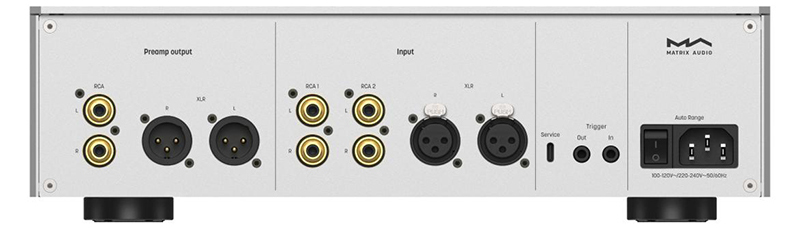
Both the headphone output and preamp output support independent two-stage gain adjustment. The high-gain mode for the headphone output provides higher voltage swing, suitable for high-impedance headphones. The high-gain mode for the preamp output suits power amplifiers or active speakers with lower gain. For output interfaces, the headphone section provides 6.35mm single-ended, 4.4mm balanced, and 4-pin XLR balanced connections. The preamp section offers both XLR and RCA outputs and can connect to up to three source inputs simultaneously.
Volume control uses a motor-driven quad-unit Type 27 potentiometer from ALPS. When adjusted via a remote, the knob rotates smoothly and automatically. This traditional analog feel and the sense of ceremony it brings are irreplaceable by digital volume control.
Sound: What multi-box-stack users Want Most
After all hardware talk, we must return to the sound itself.
I first listened to Eva Cassidy's Live at Blues Alley using the NT-1 connected to the ND-1 (in Op-Amp mode) via USB, then balanced into the NA-1 driving the HD800S. From the opening track Cheek to Cheek, most ordinary users could sense the difference with this system. Eva's voice inherently carries a texture that is husky yet bright. Many systems tend to push the vocals too forward or create an oversized vocal image with this recording. The N Series is just right. The vocals are centered in the soundstage, slightly forward, with clear but not exaggerated lip definition. Details like the tremor in her throat and subtle breaths during phrasing are all preserved without artificial sharpening.

Switching to the ND-1's LUNDAHL Transformer mode, the sound noticeably gains a layer of warmth. Listening to Steely Dan's Aja, the piano's notes become rounder, and the decay of cymbals disperses more naturally in the air. The difference between the two modes isn't earth-shattering but lies in subtle tonal tendencies. The Op-Amp mode leans towards a modern, high-resolution foundation with clear lines and sharp transients. The Transformer mode is closer to traditional analog equipment — warm, relaxed, and easy on the ears. Each mode has its ideal use case. For jazz vocals or small-scale classical, I prefer Transformer mode. For large-scale symphonies or electronic music, the Op-Amp mode's incisiveness and transparency are more fitting.

Switching to the GL3000, a planar magnetic headphone that places extreme demands on an amplifier's control and current output. Many amps struggle with the GL3000, often resulting in loose bass or overly softened mid-high frequencies. The NA-1's performance driving the GL3000 balanced is satisfactory. The bass is solid and cohesive, with just the right amount of weight — not a boomy quantity, but one where you can clearly discern the texture of each bass pluck. Listening to Marcus Miller's Power, the slap techniques of the electric bass are displayed vividly. The transient response of each slap and pop is crisp and clean, yet the attack never feels harsh or grating. This is the charm of pure Class A amplification. It can deliver ample dynamics and transients while maintaining a natural sense of relaxation, allowing for long listening sessions without fatigue.

Soundstage construction is another highlight of this system. Listening to Abbado conducting the Berlin Philharmonic in Mahler's Symphony No. 5, when the trumpet solo begins in the first movement, you can clearly perceive the musician's placement deep on the stage. As the string section enters, the entire orchestra is laid out with distinct layering — woodwinds, brass, percussion each in their place — with excellent depth and width. When large dynamic passages arrive, the advantage of the NA-1's high-voltage power supply rails becomes evident. The sound remains composed and expansive even at high volumes, without compression. The bass impact is powerful yet firmly controlled, never turning into a muddy mess.

Switching to an active speaker system, I connected the ND-1's XLR outputs directly to a pair of Neumann KH120As, using the NA-1 as a preamp. This pairing is very comfortable for listening to small-scale classical and jazz trios. The NA-1's preamp section also employs a high-voltage design with ample output level and a high dynamic range, easily driving active monitors like the KH120A, which aren't highly sensitive. Listening to Bill Evans Trio's Waltz for Debby, the piano's overtones are rich, the double bass plucks have good body, and the brush strokes on the jazz drums are delicate and airy. Driving active speakers, this system maintains the characteristically mellow texture and excellent resolution of pure Class A. Details remain abundant even at low volumes, without losing dynamics as the volume decreases.

I also tried several flagship headphones like the Focal Utopia 2, HiFiMan Susvara, Sennheiser HD800S, and Meze Poet. The NA-1's performance was consistently robust. The Utopia 2 retained its gorgeous mid-high frequencies under the NA-1's drive, while the potential sharpness of the beryllium driver was well-tamed. The Susvara's bass was driven quite fully, with an extremely dense midrange. The Poet's soundstage was expanded widely without the common hollowness in the mids. This system's adaptability to different headphones truly demonstrates 「Matrix Audio」's profound skill in tuning. I also believe this experience is greatly related to the superior tonal coordination and consistency offered by a multi-box-stack.

At the 50,000 RMB Price Segment, Who Else? Final Thoughts
In the 50,000 RMB price range, you can certainly find transports cheaper than NT-1, DACs with more "explosive" specs on paper, and headphone amps with more power. But if you're looking for a complete, integrated system covering the entire chain from source to DAC to amplifier — with no obvious hardware shortcomings, stable and smooth software experience, and sound that offers both technical ability and musicality — the choices are actually quite few. The 「Matrix Audio」 N Series is precisely the answer with the highest level of completion and the most worry-free experience at this price point.
But that's not all. Choosing this system gives you more than just sound. You also get a visually cohesive set of desktop art that integrates perfectly with, for example, an Audio Bastion custom rack. You get an ecosystem that allows for continuous upgrades — whether adding the SC-1 Audio Grade Reference Clock in the future or other peripheral optimizations, the potential of this multi-box-stack is far from capped. The certainty it provides in terms of playability and upgradability is incomparable to any pieced-together system.
So, if your budget falls in this range and you want to perfectly avoid pitfalls, assembling a desktop system that requires no tinkering, sounds reliable, looks great, and has a clear upgrade path ahead, I sincerely suggest you take your most familiar pair of headphones to an offline store or exhibition to listen to this 「Matrix Audio」 N Series in person. But I have to give a fair warning upfront: after listening, your wallet will likely feel much lighter.